Your brain is not broken. Your tools were.
Neurodivergent brains work differently -- not worse. DopaLoop was built for how your mind actually operates: nonlinear progress, fluctuating energy, and the need for flexibility without judgment. No shame. No surveillance. Just support that fits.

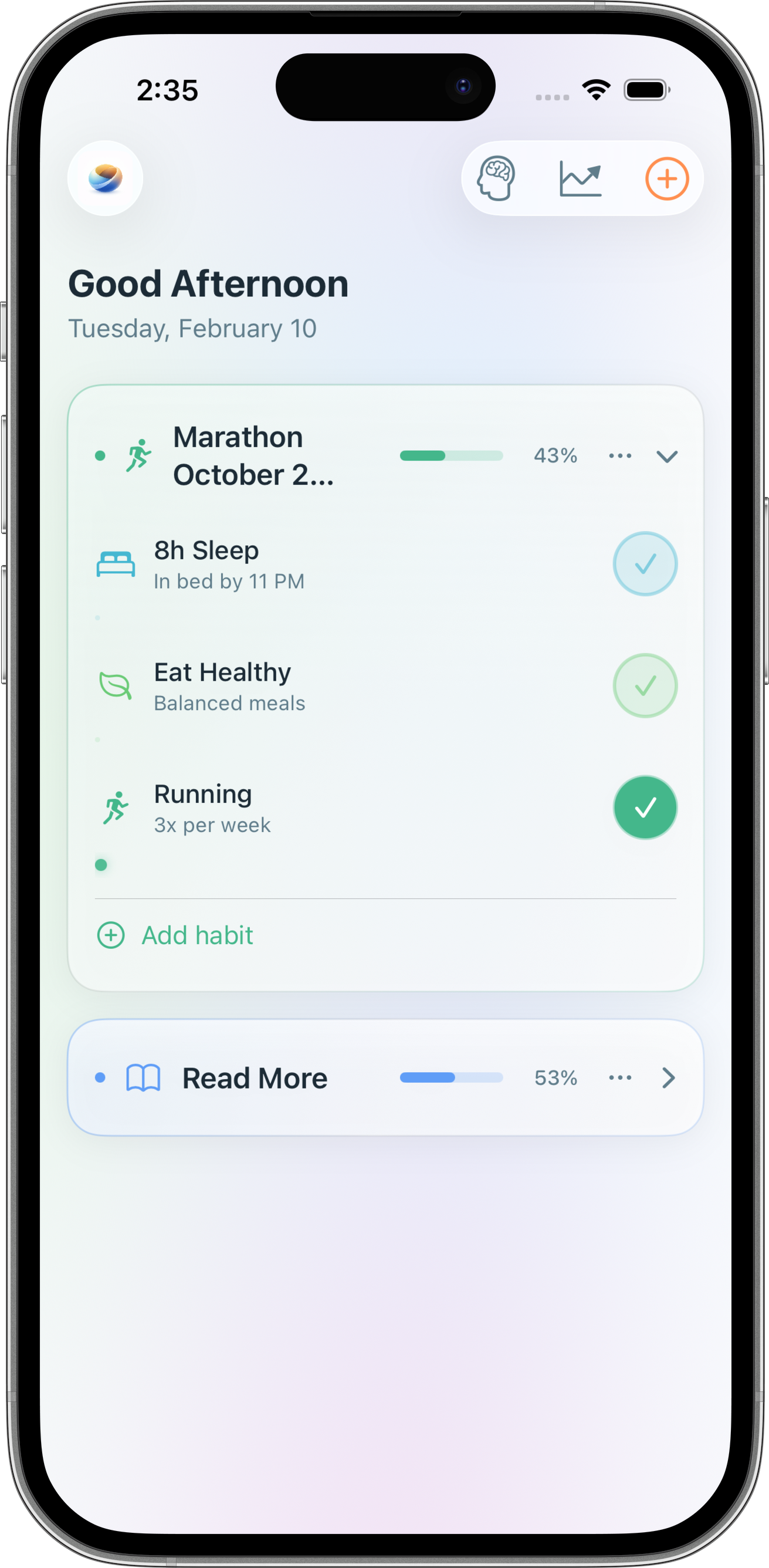
Why most habit trackers weren't built for you
Binary tracking erases your effort
You meditated for 3 minutes instead of 20. You went for a short walk instead of a full workout. You tried -- genuinely tried -- but the app only sees: Not done. For neurodivergent brains, partial effort is often monumental. Getting started at all, against executive dysfunction, against the weight of a low-energy day -- that deserves recognition. But binary trackers see only Done or Not Done. Your effort vanishes. DopaLoop's 0-5 intensity scale means a 2 is a real 2. Not empty. Not failed. A step.
Streak pressure triggers emotional spirals
"Streak lost." Two words that can ruin an entire week. For people with Rejection Sensitive Dysphoria (RSD) -- common in ADHD and AuDHD -- this isn't just disappointing. It activates the same neural pathways as social rejection. The brain interprets it as: You failed. You're not good enough. Again. Traditional streak mechanics were designed for neurotypical motivation patterns. For neurodivergent brains, they're a shame machine.
Too many decisions before you even start
Open the app. Choose a category. Pick a habit. Set the time. Configure reminders. Choose a color. For a brain with executive dysfunction, each micro-decision costs energy. Five decisions before tracking a single habit? That's not a tool -- that's an obstacle course. By the time you've configured everything, the mental energy is gone. The app stays closed. Another day untracked. More guilt.
Built for brains that work differently
Every feature in DopaLoop was designed with neurodivergent experiences in mind. Not as an afterthought -- as the foundation.
Every effort counts -- the 0-5 scale
A 1 is not failure. It's a start. The intensity scale captures the reality of fluctuating energy: some days you give everything, some days showing up at all is the victory. DopaLoop doesn't ask for perfection. It asks: Did you try? How much could you give today? And whatever the answer, it counts.
Language that never triggers shame
No "streak lost" warnings. No "you're falling behind" notifications. No red alerts that make your stomach drop. Every piece of text in DopaLoop was written with RSD awareness. Supportive, never judgmental. "Tomorrow is a fresh start" -- always. Because your brain is already hard enough on you. Your tools shouldn't pile on.
Voice journaling when words won't come
Evening. Executive function depleted. Typing feels impossible. But you have thoughts -- swirling, important thoughts that need somewhere to go. Just speak. DopaLoop uses on-device speech recognition (WhisperKit) to capture your voice journal. No cloud processing. No one listening. Your thoughts stay yours. Speaking is 3x faster than typing and removes the barrier of written language entirely.
Goals give habits meaning
Neurodivergent brains often struggle with tasks that feel arbitrary. "Track meditation" -- why? Without a clear purpose, motivation evaporates. DopaLoop's Goals-First approach connects every habit to something meaningful. You're meditating because you're working toward "Finding inner calm." The why sustains motivation when willpower can't.
Daily Plan: Fewer Decisions in the Morning
The Daily Plan shows you chronologically what's on today. No guessing what's next. Your day has a visible structure.
Your neurodivergent journey is private
Your habits, your struggles, your patterns -- this is deeply personal information. It stays on your device. No cloud, no servers, no analytics. Privacy isn't a feature. It's a right.
Frequently Asked Questions
- Shaw, P., Stringaris, A., Nigg, J., & Leibenluft, E. (2014). Emotion Dysregulation in Attention Deficit Hyperactivity Disorder. American Journal of Psychiatry, 171(3), 276-293.
- Leitner, Y. (2014). The Co-Occurrence of Autism and Attention Deficit Hyperactivity Disorder in Children -- What Do We Know? Frontiers in Human Neuroscience, 8, 268.
- Barkley, R. A. (2015). Attention-Deficit Hyperactivity Disorder: A Handbook for Diagnosis and Treatment. Guilford Press.
From the developer — reframe, not defect
What neurodivergence actually means day-to-day
I'm Stephan, 48, software engineer for about 25 years, ADHD diagnosed late. "Neurodivergent" is one of those words I'd never have used before my diagnosis because it sounded like a Twitter bio. Today I use it because it names something precisely that I had no language for before: not every brain works the same way, and that isn't a question of right or wrong.
This page isn't academic and isn't activist. It's the version I would have wanted ten years ago — before the diagnosis, when I didn't know there was a name for "why don't I work the way everyone else seems to."
Where the term comes from
The term neurodiversity was coined in the late 1990s by Australian sociologist Judy Singer in her honours thesis, and first appeared publicly in 1998 in an article by US journalist Harvey Blume in The Atlantic. Singer modeled it on "biodiversity": just as ecosystem stability rests on a diversity of biological species, cultural stability rests on a diversity of neurological profiles.
From "neurodiversity" (the phenomenon) came "neurodivergent" (the adjective for an individual profile diverging from the statistical norm). The umbrella usually covers: ADHD, the autism spectrum, dyslexia, dyspraxia, dyscalculia, Tourette syndrome, highly sensitive perception. The exact list is debated — the term is descriptive, not clinical.
Important: "Neurodivergent" doesn't replace a diagnosis. It's an identity term, a self-description that works differently from a DSM code. Anyone who identifies as neurodivergent typically has a concrete diagnosis (or a very strong suspicion) plus the decision not to treat it as a defect.
What the reframing changes in practice
Sari Solden gave her 2005 update the subtitle Embrace Your Differences and Transform Your Life. That isn't wellness wallpaper — it's the operational consequence of the neurodiversity idea: not "fix yourself," but "learn to live with your differences in a way that holds." Three decades of research — Solden in adult clinical work, Russell Barkley on self-regulation theory, Edward Hallowell on the strengths model — converge on the same point: a brain profile that works differently is not defective; it needs different tools.
I spent four decades feeling that something about me was broken. Not clinically depressed — more chronically frustrated. Why do other people do their tax return in February while I only finish it in December under panic pressure? Why do I forget where I parked when I'm stressed? Why do standard productivity tricks (Bullet Journal, GTD, Eisenhower Matrix) work for me for six weeks at most?
The answer shifted with the diagnosis. Not because the behavior suddenly disappeared — it's still there. Because the inner monologue changed. Instead of "why am I so undisciplined" it became "my reward system works differently, and that's measurable; what concretely helps that."
This isn't therapeutic framing. It's neurochemically grounded. For ADHD, Volkow et al. (2009) in JAMA used PET scans to show that the mesolimbic dopamine system is measurably reduced — fewer D2/D3 receptors in the nucleus accumbens region. "Undisciplined" is the external description for "my reward system fires less." One is a character attribution, the other a neuropsychological fact.
For the autism spectrum, research points in similar directions: differences in sensory processing, social pattern recognition, executive function — not "worse," but different, with their own strengths (detail focus, systems thinking, sensory sensitivity) and their own limits.
The reframing "neurodivergent rather than defective" doesn't shift the problem. It shifts where the solution has to come from. Not from self-blame. From tools built for that brain profile.
What that means for everyday tools
Most productivity tools were designed for a neurotypical brain. They reinforce consistency because they assume consistency is the default. For an ADHD brain, an autistic brain, a dyspraxic brain, consistency isn't the default — it's the hardest thing. The tool that presupposes consistency burns energy instead of saving it.
Concretely in habit-tracking apps: binary completion ("done/not done") presupposes your days look similar. Streak mechanics presuppose stability is the norm and breaks are exceptions. Both are assumptions that fall off the back of an ADHD brain in the morning. The result: the app feels like persistent failure because it systematically measures what you're least able to do.
An alternative is building tools that work with the brain reality instead of against it. In DopaLoop concretely:
- Intensity scale 0–5 instead of binary. A 3-out-of-5 completion isn't "not done." It's the most common reality of a fluctuating-energy day.
- Goals-First. Habits serve a goal you're pursuing — not a checkmark counter. That addresses the "what for" problem that hits harder with a reduced reward system.
- No streak punishment. No streaks in the classic sense. Breaks are allowed without the app yelling at you. For RSD-sensitive brains that isn't a comfort feature — it's a precondition for using the app at all. (What RSD is.)
- Local on the device. Neurodivergent data — habit patterns, mood patterns, sleep correlations — is sensitive. In DopaLoop it doesn't land in a cloud. No server code, no user DB, no analytics SDK. That's architecture, not marketing.
What this page explicitly doesn't claim
"Neurodivergent" isn't a blanket explanation for everything that's difficult. If you're chronically exhausted, that could be thyroid, sleep apnea, depression, iron deficiency, post-traumatic stress disorder — a whole list. A diagnosis is made by a person with medical training, not by an online test and not by a habit-tracking app.
What this page proposes isn't "read this and you'll know what's going on." It's: if you recognize yourself in the description, that's a signal to pursue professional evaluation. If you don't, that's also a result.
What this page isn't: a political manifesto against clinical diagnoses. I find the ICD classification useful and identifying as neurodivergent simultaneously meaningful. They complement each other. One is the medical language, the other the everyday-practical one.
And finally: this page is a software landing page, not a textbook. If you want to go deeper, read Judy Singer's original texts, Devon Price, Sari Solden. It's worthwhile reading — whether you end up with a diagnosis or not.
About the author
Stephan Eberle · Founder, DopaLoop
I'm Stephan, a senior engineer with 25+ years on the job and a late-diagnosed ADHDer. I'm building DopaLoop for the brains that standard habit trackers grind down — private, on-device, goals-first. On Medium I write openly about shipping anxiety, hyperfocus, and the rabbit-hole portfolio effect.
An app that works with your brain -- not against it
No streak shaming. No guilt. No surveillance. Just tools that understand.