You didn't fail. Habit trackers failed you.
Built by someone who has been there. DopaLoop celebrates every step you take. No shame when you forget. No pressure to be perfect. Just support, exactly when you need it. You are not doing this alone.

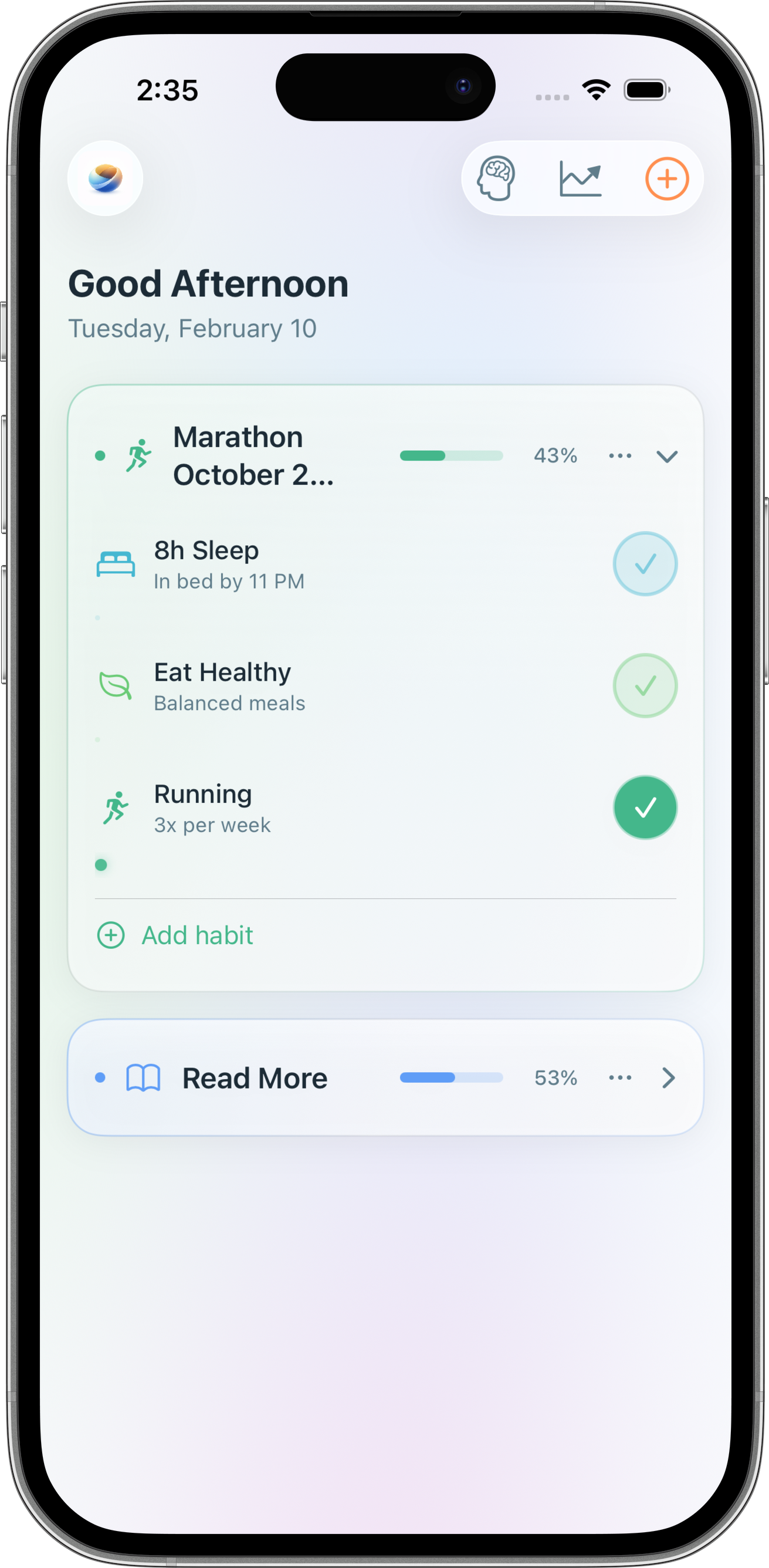
You know the feeling
"I forgot again." And you feel like a failure
It's 10 PM. You open the app. Empty. Again. The streak is gone. The app makes sure you know: "5 days lost". You feel like a failure, even though you accomplished so much today. Just didn't think about the app. This shouldn't feel like failure. But with RSD (Rejection Sensitive Dysphoria), your brain searches hypervigilantly for signs of rejection, and finds it in "Streak Lost". That hurts. Every time.
"All or nothing." Gray areas don't exist
Meditated for 2 minutes instead of 20? The app shows: Not done. Empty. As if nothing happened. But 2 minutes is better than 0. You did your best. Executive dysfunction is real. Sometimes 2 minutes is all you've got. And that should count. But the app only sees: "Done" or "Failed". No gray. Just black or white. This feels like constant failure. Because it is failure, in the app's eyes.
"Just start!" But your brain can't
The motivation is there. The will is there. But your brain? Paralyzed. Complex apps with 15 different options, 3 menus, and "Custom Routine Builder" overwhelm. You just want to track. But the app wants you to make 20 decisions first. Executive dysfunction means: Decisions cost energy. Too many options = paralysis. So you don't open the app. Another day forgotten. More shame.
DopaLoop understands your brain
I built every feature because I needed it myself. Here is what that looks like.
Small steps count too
A 5-minute meditation is a success. Not perfect, but real. With the 0-5 scale, you celebrate every step. Even if it's small. DopaLoop sees your progress, even when it doesn't look perfect. 2 minutes? That's a 2 on the scale. Not empty. Not "failed". A real step forward. Your brain works differently. DopaLoop adapts. Not the other way around.
Breaks belong to the journey. Not to failure
One missed day doesn't erase your work. Forgiving Streaks means: DopaLoop gives you room to breathe. No "Streak Lost". No guilt trip. No red warnings. Just: "Tomorrow is a fresh start." Always. With ADHD, not all days are equal. Sometimes "surviving" is already success. DopaLoop knows that. And doesn't judge.
Speak when typing is too much
Voice Journaling is like thinking, but out loud. No barrier. No grammar. No perfection. Evening, when mental energy is gone. Just speak. 30 seconds. Your thoughts are captured. No typing. No overthinking. Simply: Speak. Your thoughts are faster than your fingers. DopaLoop keeps up.
Your "Why" keeps you motivated
Goals-First means: Your habits have meaning. Instead of tracking "Meditation", you're working on "Finding Inner Peace". The "Why" is the key. Not streak numbers. Not gamification. Real meaning lasts longer than any artificial motivation. You're working on something that matters to you. DopaLoop reminds you of that.
Daily Plan: Structure Without Overwhelm
Swipe left to see today's habits sorted by time. No scrolling through endless lists. Just what's on today.
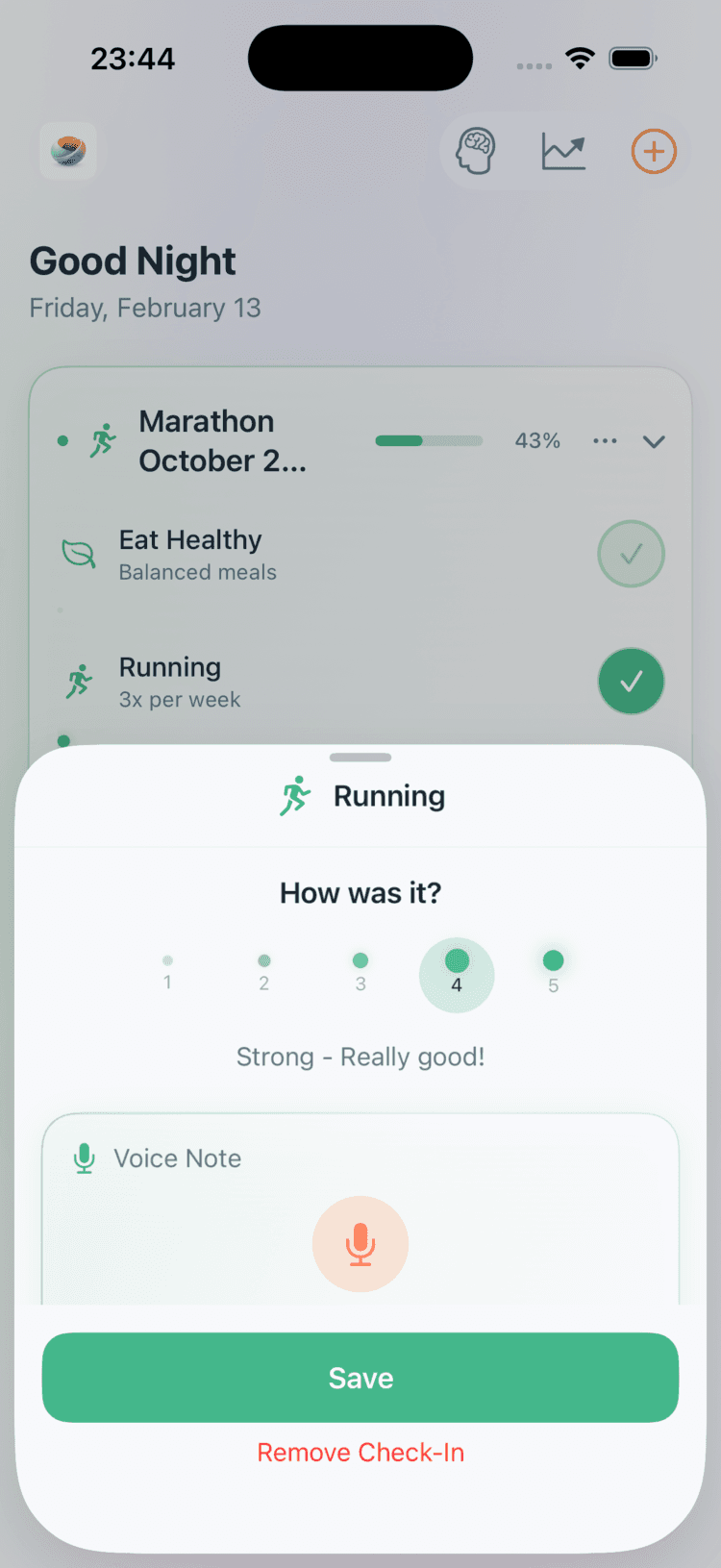
ADHD-friendly tracking in action
Rate your habits 0-5 instead of just checking a box. Miss a day and nothing breaks. That's what ADHD-friendly actually looks like.
Your data stays with you
All data on your device. There are no servers. I literally cannot see your habits even if I wanted to.
Why I built DopaLoop
I am Stephan. I have been writing code since I was a kid, roughly 40 years now. I got my ADHD diagnosis at 47. Late. Looking back, 40 years of code suddenly made sense: the parallel projects, the deep dives at 2 AM, the burnout-recover-burnout cycle. The diagnosis did not fix anything. It just gave me the pattern. I built DopaLoop because every habit tracker I tried treated my brain like the problem. Empty streaks. Red warnings. "You missed a day." That made me feel worse, not better. So I built one that does not. If any of this sounds familiar, you are not alone. There is a whole generation of us, diagnosed late, trying to figure out how to be kinder to ourselves. DopaLoop is what I needed. I hope it helps you too.
ADHD in everyday life
ADHD in Women
Why the diagnosis so often arrives decades late.
→ADHD Paralysis
When you know what to do and still cannot move.
→Procrastination
With ADHD, putting things off is not a willpower problem.
→Emotions and ADHD
Emotional dysregulation as a core feature, not a side effect.
→ADHD at Work
Focus, structure and a sense of time on the job.
→ADHD in Relationships
What RSD and forgetfulness do to closeness.
→Exercise
Twenty minutes of walking act on executive function.
→Nutrition
Blood sugar, protein, and what of that is actually established.
→Medication
What DopaLoop says about it, and what it does not.
→Free Trial
14 days, no account and no card.
→FAQ
- Shaw, P., Stringaris, A., Nigg, J., & Leibenluft, E. (2014). Emotion Dysregulation in Attention Deficit Hyperactivity Disorder. American Journal of Psychiatry, 171(3), 276-293.
- Barkley, R. A. (1997). Behavioral inhibition, sustained attention, and executive functions: Constructing a unifying theory of ADHD. Psychological Bulletin, 121(1), 65-94.
- Locke, E. A., & Latham, G. P. (2002). Building a practically useful theory of goal setting and task motivation: A 35-year odyssey. American Psychologist, 57(9), 705-717.
- Neff, K. D. (2003). Self-Compassion: An Alternative Conceptualization of a Healthy Attitude Toward Oneself. Self and Identity, 2(2), 85-101.
- Renfree, I., Harrison, D., Marshall, P., Stawarz, K., & Cox, A. (2016). Don't Kick the Habit: The Role of Dependency in Habit Formation Apps. In Proceedings of the 2016 CHI Conference Extended Abstracts on Human Factors in Computing Systems (CHI EA '16), 2932-2939. ACM.
Ready to try this together?
14 days free. If it does not click, delete it. Your data was on your phone anyway. No commitment, no card needed.