Do I have ADHD? The first step starts with you.
Average wait time for an ADHD diagnosis: 10 months in Germany, often longer elsewhere. You deserve clarity sooner. The ASRS-v1.1 Self-Check in DopaLoop gives you an initial assessment - validated, private, and without registration. Right on your iPhone.

Why the path to clarity is so hard
Months of waiting - and every day you wonder: "Do I have ADHD?"
You finally found the courage to think about ADHD. You recognize yourself in the descriptions. You want clarity. But reality: months-long wait times for a diagnostic appointment. Months in limbo. Months of doubt. This is especially hard when your brain is already hypervigilantly searching for validation. You deserve an initial assessment sooner.
Online tests that send your answers to unknown servers
You google "ADHD test online". Dozens of results. You click on a test - and get asked for your email address. Or need to create an account. Or your data ends up on a server you don't know. Your most intimate answers about mental health - on unknown servers. Without knowing who reads them. Without control. That doesn't feel safe. Because it isn't.
Test once - then what? No history, no comparison
You take an online test. Once. Get a result. And then? How have your symptoms changed over the past months? Is the new strategy you're trying helping? Are things getting better or worse? No idea. A screening without history is like a photo without an album. A moment, but no picture of your journey.
Your ADHD Self-Check - private and on your device
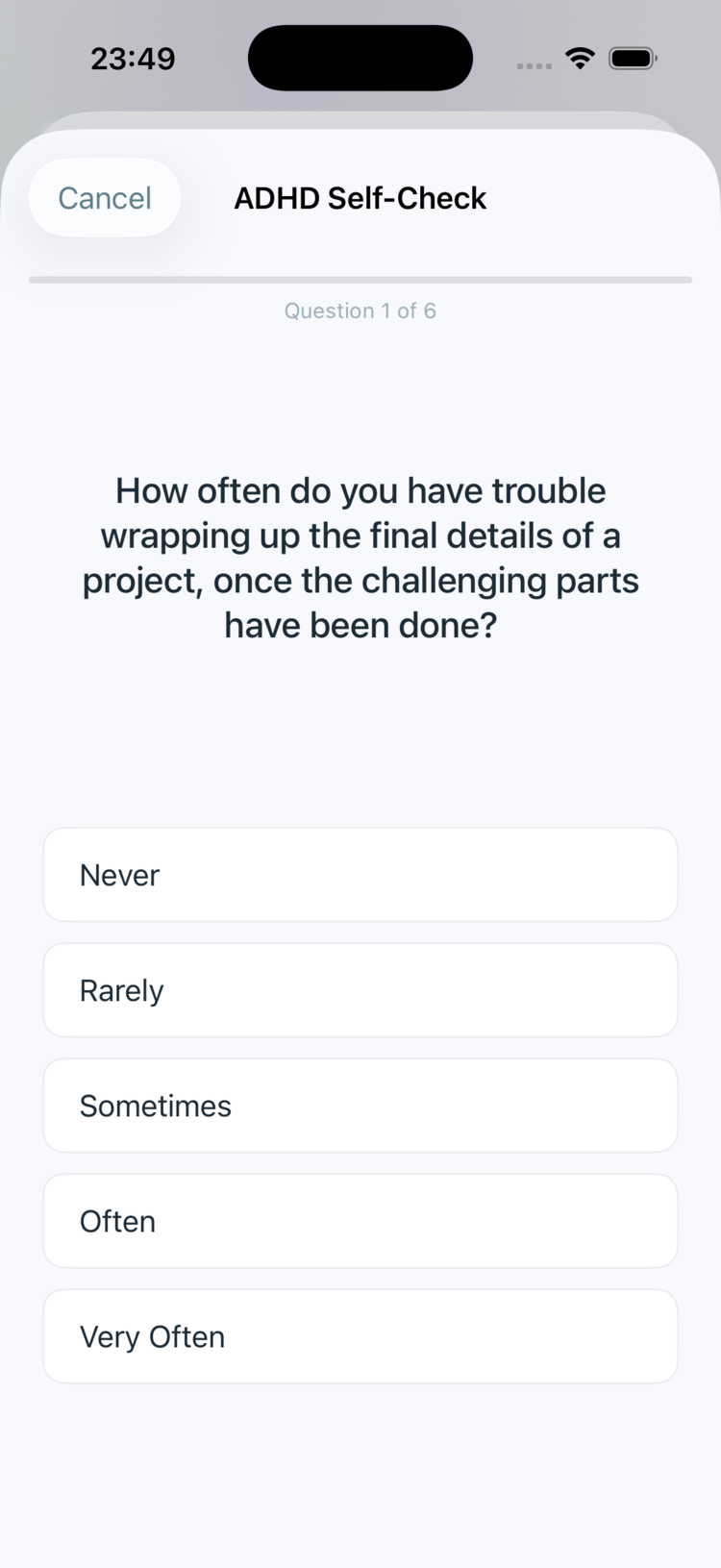
The validated WHO ASRS-v1.1 screener, right inside DopaLoop. No cloud, no registration, with history tracking.
Validated ASRS-v1.1 right in the app
The ASRS-v1.1 (Adult ADHD Self-Report Scale) was developed by the WHO and Harvard and is the most widely used ADHD screener for adults worldwide. In DopaLoop, you can complete the full Self-Check right on your iPhone. 18 questions. Clearly worded. Scientifically validated. Not a replacement for diagnosis - but a solid first step.
Your answers stay on your device
No cloud. No server. No registration. Your answers never leave your iPhone. When it comes to mental health questions, privacy isn't optional - it's essential. DopaLoop stores everything locally. Period. You decide who sees your results. Nobody else.
Track your progress over time
Take the Self-Check regularly and see how your scores develop. After starting therapy. After medication adjustments. After behavioral changes. DopaLoop shows you your history - so you don't just have a snapshot, but can see your journey. This gives you and your therapist valuable insights.
Share results with your therapist
When you're ready, you can export your Self-Check results as a PDF and share them with your therapist or doctor. Structured data instead of vague memories. This helps in diagnostic conversations and saves time. You decide what you share. And with whom.
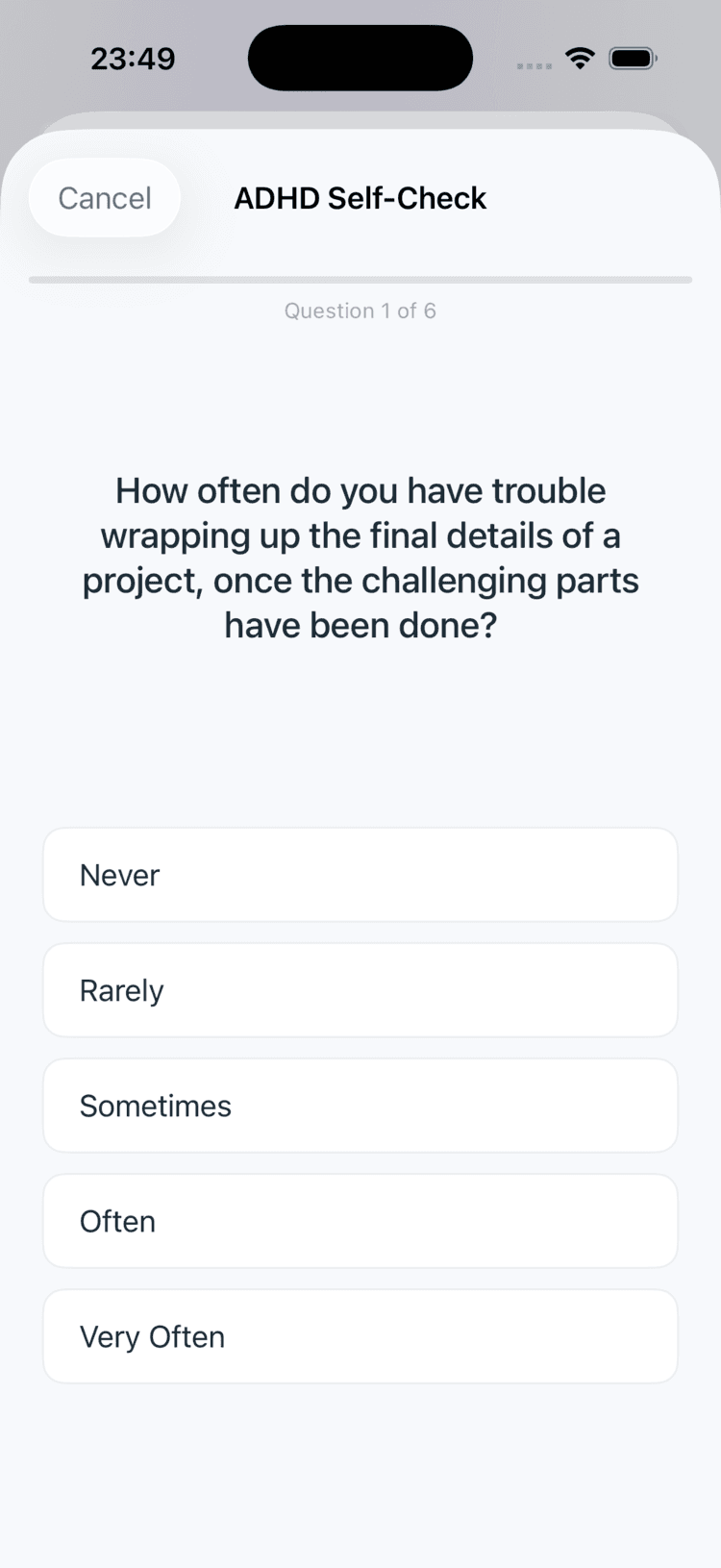
Your ADHD screening in the app
The validated ASRS-v1.1 screener directly in DopaLoop. Track your results over time and share them with your therapist when needed.
Mental health deserves absolute privacy
Your ADHD screening results are highly sensitive. That's why they never leave your device. No cloud, no analytics, no tracking. Just you and your iPhone.
Why the Self-Check matters to me
I (the developer) have ADHD myself - and I know what the path to diagnosis feels like. The googling at 3 AM. The online tests where you don't know where your data goes. The months-long wait. I wanted a Self-Check that: • Is scientifically validated (WHO ASRS-v1.1) • Respects my data (everything on-device) • Shows me a history (not just a snapshot) • Helps me prepare for the conversation with my doctor This Self-Check doesn't replace a diagnosis. But it gives you a solid initial assessment - private and on your device.
FAQ about the ADHD Self-Check
- Kessler, R. C., Adler, L., Ames, M., Demler, O., Faraone, S., Hiripi, E., ... & Walters, E. E. (2005). The World Health Organization Adult ADHD Self-Report Scale (ASRS): a short screening scale for use in the general population. Psychological Medicine, 35(2), 245-256.
- Kessler, R. C., Adler, L. A., Gruber, M. J., Sarawate, C. A., Spencer, T., & Van Brunt, D. L. (2007). Validity of the World Health Organization Adult ADHD Self-Report Scale (ASRS) Screener in a representative community sample. International Journal of Methods in Psychiatric Research, 16(2), 52-65.
- World Health Organization (2003). Adult ADHD Self-Report Scale (ASRS-v1.1) Symptom Checklist. WHO Composite International Diagnostic Interview.
From the developer — before the self-test
Before you take the self-test — please read this
I'm Stephan, 48, diagnosed with ADHD at 47. I'm not a psychiatrist, not a therapist, not a doctor. I'm a software engineer who, after decades of feeling "something's not right with me," eventually stumbled across an ASRS self-test that made me properly nervous for the first time. Three months later I had a clinical diagnosis.
This page doesn't provide a self-test that diagnoses you. No such test exists. What exists is a scientifically developed screening scale that indicates whether suspicion of ADHD is strong enough for you to take the next step — an evaluation by someone who is licensed to make the diagnosis. That scale is what I'm describing on this page.
If you landed here because you're currently asking yourself whether what you observe in yourself could be ADHD: that's a good reason to keep reading. And an even better reason to book an appointment at an ADHD evaluation practice by the end.
What the ASRS-V1.1 is (and isn't)
The Adult ADHD Self-Report Scale (ASRS-V1.1) is the most widely used standardized screening scale for ADHD in adults. It was developed by a World Health Organization (WHO) workgroup together with the WHO World Mental Health Survey Initiative and published in 2005 by Kessler et al. in Psychological Medicine ("The World Health Organization Adult ADHD Self-Report Scale (ASRS): a short screening scale for use in the general population"). The questions match DSM-IV/DSM-5 criteria, worded for how ADHD manifests in adults — not how it shows up in children.
The full scale has 18 items. The short form — the 6-item screener (Part A) — contains the six questions Kessler et al. found correlated most strongly with a clinical ADHD diagnosis. These six are what many online self-tests use.
What the ASRS can: indicate whether clinically relevant suspicion of ADHD exists.
What the ASRS cannot: make a diagnosis. No one receives an ADHD diagnosis through an online test. A diagnosis requires a clinical interview, often with childhood history-taking, sometimes with additional neuropsychological testing. In the US this is typically done by a psychiatrist, sometimes a psychologist with relevant experience; in many European systems it's a specialist physician for psychiatry and psychotherapy.
Why late-diagnosed ADHD often stays hidden for decades
In 1995 Sari Solden's Women with Attention Deficit Disorder: Embrace Your Differences and Transform Your Life effectively closed the gap left by the then-dominant picture of "ADHD = hyperactive boy." Her finding — three decades of clinical work later largely confirmed — is that women in particular, and quietly-compensating men, are chronically underdiagnosed, often carrying decades of shame as a companion before the diagnosis finally lands. My own path matches that pattern exactly.
Three reasons that fit my own case and recur throughout the literature:
High-functioning compensation. Many adults with ADHD have built strategies over decades that allow functioning — above-average intellect, hyperfocus on interesting domains, workaholic patterns, hard self-discipline. That works for a long time. Until it doesn't (burnout, layoff, family crisis), and suddenly the deficit lies exposed.
False stereotypes. The classic picture is the hyperactive boy who can't sit still. Adult ADHD presentation — especially in women, but not only — often looks completely different: chronic exhaustion, RSD (Rejection Sensitive Dysphoria), emotional dysregulation, "inner restlessness rather than outer," difficulty with work organization despite high intelligence. That rarely gets recognized because it doesn't match the textbook image.
Comorbid diagnoses mask it. Many adults receive diagnoses over the years like depression, anxiety disorders, burnout. That isn't wrong — these comorbidities are real and need treatment. But if the underlying ADHD stays undetected, the person carries the wrong primary diagnosis. The NCS-R study by Kessler et al. (2006) in the American Journal of Psychiatry showed in a US population sample that only about 11% of adults with ADHD had received treatment for the disorder within the past 12 months — against a prevalence of around 4.4% in the adult general population.
When the self-test flags something — what next?
Up front: an elevated ASRS score isn't an emergency and isn't a crisis. It's a signal that further evaluation makes sense. What you can do — in this order:
1. Write down what you observe. Concrete situations. "I regularly forget where I parked." "I've never sustained a routine for more than six weeks." "Trivial criticism throws me off for days." Concrete examples help enormously in the first appointment — more than abstract self-description.
2. See your primary care doctor. That's the standard entry into the mental health pathway. Ask for a referral to a psychiatrist or psychologist with ADHD experience — "I have an elevated ASRS score and suspect ADHD" is a normal reason and not an embarrassing one.
3. Plan for patience. Waiting times for an appointment at an ADHD-specialized practice can run several months in many countries. In the meantime, reading helps — and honest self-mapping. Russell Barkley, Edward Hallowell, Sari Solden are good starting authors. You'll recognize yourself in much of it, or you won't. Both are information.
4. Consider differential diagnoses. Symptoms like concentration problems, exhaustion, emotional dysregulation aren't unique to ADHD. Thyroid dysfunction, depression, sleep apnea, iron deficiency, post-traumatic stress disorder can look similar. A good initial workup rules these out. Anyone who walks into a practice with "I think I have ADHD" and isn't open to other explanations walks out with the wrong diagnosis.
Why a habit-tracker app on this page?
This page lives on dopaloop.app, and I build DopaLoop — a habit-tracker app for ADHD brains. I'm not going to pretend the link to this page is here by accident. But I'm also not going to claim an app replaces a diagnosis or is a tool for the pre-diagnosis phase.
If you're currently in the "I suspect I might have ADHD" stage — don't install an app. Make the appointment. Read an entry-level classic (e.g., "Driven to Distraction" by Hallowell and Ratey). See whether the description hits.
If you're post-diagnosis and looking for a daily tool that doesn't work against your brain — DopaLoop may make sense. Goals-First, intensity 0–5 instead of binary, local on the device, no streak-shaming mechanics. (What Goals-First means concretely.)
But the app isn't the solution to a diagnosis problem. Only the diagnosis itself solves that — and the path there goes through a clinical practice, not the App Store.
About the author
Stephan Eberle · Founder, DopaLoop
I'm Stephan, a senior engineer with 25+ years on the job and a late-diagnosed ADHDer. I'm building DopaLoop for the brains that standard habit trackers grind down — private, on-device, goals-first. On Medium I write openly about shipping anxiety, hyperfocus, and the rabbit-hole portfolio effect.
Ready for your first step?
Take new self-checks during your trial or with a subscription or Lifetime. You can still view and export existing results.