Habitica is fun. DopaLoop is understanding.
Habitica turns habits into a game – and for many people, that works. But gamification has a dark side: HP loss, streak penalties, and team damage. For ADHD brains with RSD, that's not fun. It's shame. DopaLoop takes a different path.

The honest comparison
Habitica pioneered habit gamification. This is where DopaLoop takes a different approach.
| Feature | DopaLoop | Habitica |
|---|---|---|
| Approach | Goals-First | Gamification (RPG) |
| ADHD Safety | Supportive Language | HP Loss on Failure |
| Privacy | 100% On-Device | Cloud Servers (5.3/10 PrivacySpy) |
| Apple Watch | Yes | No |
| HealthKit | Yes | No |
| Voice Journaling | On-Device | No |
| Community | Solo | Parties, Guilds, Quests |
| Price | See App Store | Free (sub optional) |
Prices may vary by region and local taxes.
Why users switch to DopaLoop
No punishment: Progress without fear
In Habitica, missing a habit costs HP. Miss too many? Your character dies. Your party members take damage. For ADHD brains with Rejection Sensitive Dysphoria, this triggers shame spirals. DopaLoop has zero punishment mechanics. Every day is a fresh start.
Privacy you can verify
Habitica runs on cloud servers. PrivacySpy rates their privacy at 5.3/10. Your habits, your struggles, your patterns – stored on someone else's servers. DopaLoop keeps everything on your device. No servers. No accounts. No data to breach.
Goals-First: Meaning over points
Habitica motivates with XP, gold, and loot. DopaLoop motivates with purpose. Your habits serve goals – not a virtual avatar. When the novelty of gamification fades, meaning remains.
Apple Watch: Track from your wrist
Habitica has no Apple Watch app and no HealthKit integration. DopaLoop lives on your wrist – 3-second check-ins without reaching for your phone.
Voice Journaling: Reflect, don't just check
Habitica is about completing tasks. DopaLoop adds reflection. Voice journaling captures how you feel – not just what you did. On-device, private, in 60 seconds.
HealthKit Integration
Sleep, steps, workouts – automatically tracked and connected to your goals. Habitica can't access HealthKit at all. DopaLoop makes your health data meaningful.
Switching is easy
From Habitica to DopaLoop in 5 minutes – here's how
- 1Identify your Habitica Dailies and Habits that genuinely matter (ignore the ones you kept for XP)
- 2Create goals in DopaLoop that give those habits purpose (e.g. 'Mental health', 'Physical fitness', 'Learning')
- 3Add your meaningful habits – now with 0-5 intensity instead of binary completion
- 4Leave the gamification behind. No more HP, no more guilt. Just you and your goals.
From the developer — where it broke for me
Habitica for two months, then radio silence
I used Habitica consistently for about two months. I'm Stephan, 48, diagnosed with ADHD at 47, and Habitica was one of the first habit trackers I tried seriously after the diagnosis. It worked for a while. Then it stopped, very abruptly.
This page isn't "Habitica is bad, use my app." Habitica is exactly the right tool for a lot of people with ADHD. The RPG mechanic delivers what a binary list doesn't: a short, clear reward moment after every checkmark. With a reward system that, per Volkow et al. (2009, JAMA), works measurably differently with ADHD — fewer D2/D3 receptors in the nucleus accumbens region — that's a real lever. With around four million users and a free full version, Habitica is popular for good reasons.
This page is for the other half: people for whom Habitica tips over after a few weeks. And for the question of what's actually happening, neurobiologically.
What Habitica genuinely does well
Edward Hallowell, Harvard psychiatrist and co-author of Driven to Distraction (1994), works explicitly from a strengths-based model of ADHD — the idea that an ADHD brain isn't simply "broken," it needs different levers. Gamification fits exactly there: it adds stimulus rather than addressing deficit. For a subset of ADHD brains, that works.
Habitica is free, with no hidden paywall — the paid tier delivers cosmetic items, no functional advantage. The app is fueled by a genuinely active community with ADHD-specific guilds and quests that run across multiple people. If accountability through social context motivates you, Habitica offers more than most solo apps.
The RPG layer — XP, gold, equipment, classes, bosses — produces an immediate reward moment that, for the ADHD-typical dopamine deficit, fills a gap. It's substantially more than "green checkmark." It's a classic game loop, glued onto everyday tasks.
If Habitica has been moving you forward for years and is still carrying you: this page isn't for you. Really not.
Where it tipped over for me
What happened to me after eight weeks felt like betrayal. A week in which I was actually productive — a lot of small, unplanned things, calls shifted, family visiting, the usual life — and I didn't manage to tick everything off in the app each evening. My character "starved" in the game. HP gone. Equipment damaged. The app punished me for a productive week.
That sounds small. For an RSD-sensitive brain — and that's many of us with ADHD — it isn't small. It's the exact "you failed" signal I heard internally for decades before the diagnosis. (What RSD is.)
Diefenbach & Müssig documented this cleanly in 2019 in the International Journal of Human-Computer Studies: in a two-week field study with 45 Habitica users, all experienced counterproductive effects. The most common was exactly what happened to me — being punished by Habitica precisely because you were productive (and therefore didn't get to the app). That's a design collision, not user error.
The second thing: gamification works through novelty. Quest, boss, new equipment. If the game system doesn't supply new stimuli at regular intervals, it loses its reward value. My personal usage curve hit a wall around the ten-week mark — class done, first bosses cleared, the "mid-game grind" started. My reward system switched off. And with it my habit-tracking discipline.
What gamification costs, what it doesn't replace
Habitica has a strength that's also its weakness: it turns habits into a game. If the game were quiet and unobtrusive, nothing would happen. Because it's playable, it eats attention. With ADHD, attention is a resource I don't want to hand over to a cartoon avatar in the morning.
That's not a criticism of Habitica. It's an observation about trade-offs. The app is honest about what it does. It doesn't hide the game. If you want the game, you're in the right place. If you stop wanting the game on the sixth avatar change, you have a problem.
And Habitica doesn't address one other thing: habits without an overarching goal. You track twelve habits because they're there. The "for what" isn't part of the system. That's not specifically a Habitica weakness — almost every habit tracker works that way. But Goals-First thinking costs the app nothing and wins a lot for ADHD brains whose reward system actually responds to "why am I doing this."
What DopaLoop does differently — and what it honestly doesn't do
DopaLoop isn't an RPG. If you loved Habitica because of the quests and find my tool boring without them, that's a fair point. I can't replace those stimuli. I'm not trying to.
What I do differently:
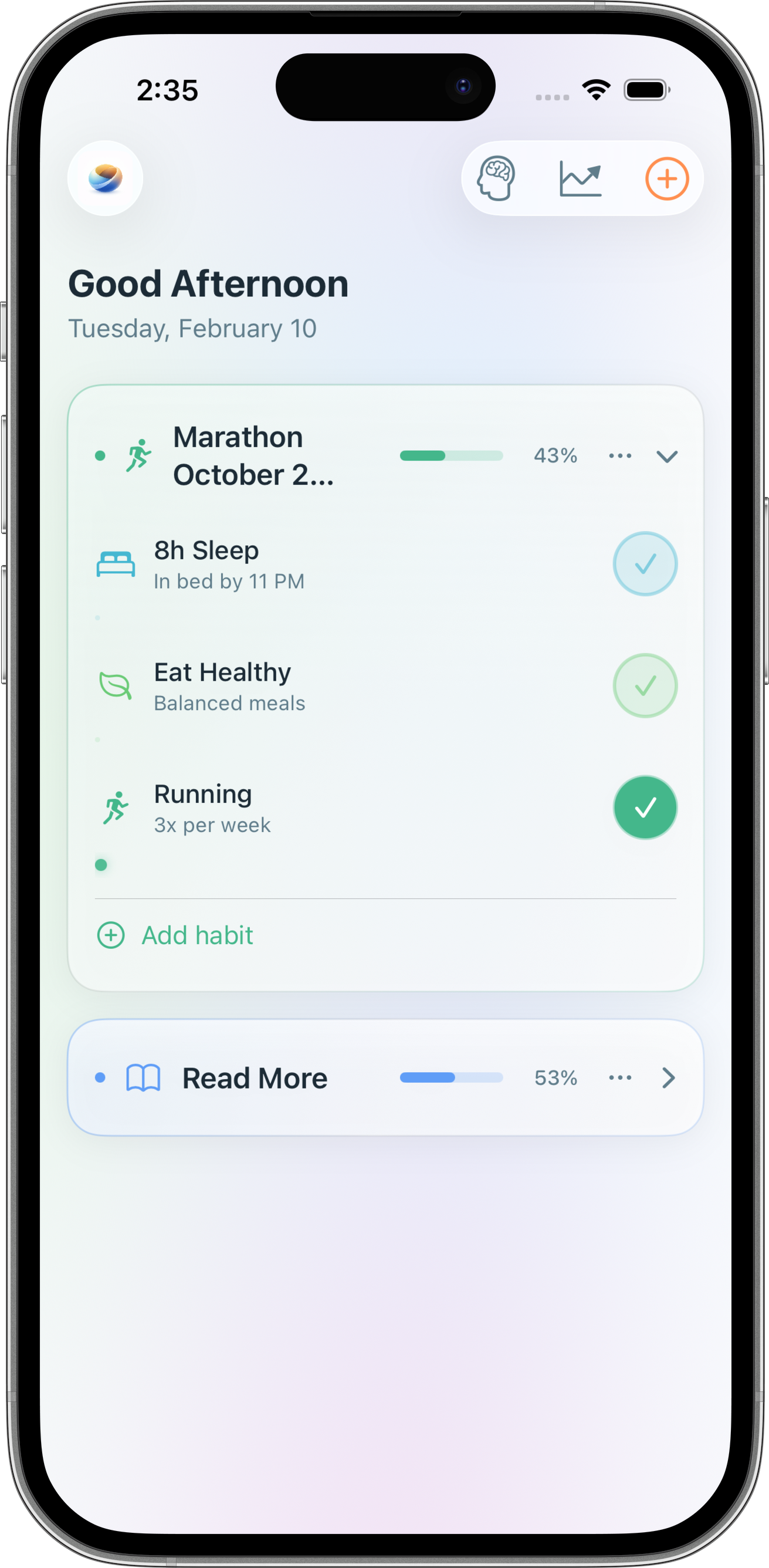
- Goals-First. Habits hang off a goal, with weight. Goal progress is the central display — not an XP counter, not a habit count. That addresses the "what's it for" problem directly.
- Intensity 0–5. Not "done" or "not done." A productive week in which I half-managed two days looks in DopaLoop like a productive week, not like a broken one.
- No punishment. No HP to lose. No streak that yells at you when it breaks. Skip a day, tomorrow is a fresh start. Full stop.
- Local, no account. Habitica syncs through its own cloud (necessary for multiplayer quests). DopaLoop has no server — everything stays on the device. Watch sync runs through
WatchConnectivity. That's architecture, not marketing.
When to stay with Habitica
Concretely. Stay with Habitica if these apply to you:
- You need social accountability through guilds and quests
- The short reward per checkmark is exactly what gets you to open it in the morning
- You have your own strategy for the "productive-week punishment" thing
- You want to stay free of charge (DopaLoop has a 14-day trial then a subscription)
When an alternative like DopaLoop makes sense:
- You've started Habitica twice and dropped it both times after 6–10 weeks
- You don't want to open the habit display every day — the app should support in the background, not perform in the foreground
- Goals-First (habits serve a goal, not the other way around) is a better anchor for your brain than "level up"
- Local data without cloud is non-negotiable
That's not a complete list. It's an honest one.
What I wish I'd known two years ago: habit-tracking tools aren't universal. A game system meets one brain profile, an intensity scale meets another. Whoever finds the app that vibrates with their brain instead of against it has won — regardless of which vendor is behind it.
FAQ
About the author
Stephan Eberle · Founder, DopaLoop
I'm Stephan, a senior engineer with 25+ years on the job and a late-diagnosed ADHDer. I'm building DopaLoop for the brains that standard habit trackers grind down — private, on-device, goals-first. On Medium I write openly about shipping anxiety, hyperfocus, and the rabbit-hole portfolio effect.
Ready for habits without punishment?
Goals-First, ADHD-safe, 100% private. No HP loss. No shame.