Reminders in your tone, per habit
Three tiers per habit. Loudness and persistence configured separately. Works inside your Morning and Evening Routines too.

One dial for everything does not work
Water and medication need different loudness
The reminder to drink water can be quiet. The reminder for your medication cannot. When both sit on the same setting, you over-correct one and miss the other.
Loudness and repeat were glued together
Until v1.1.13 you had to pick between Gentle, Time Sensitive, Persistent, and Live Activity. But those are actually two separate questions: how loud the first reminder is, and how often it returns if you do not answer.
Silent Mode breaks no notification
When your phone is silenced, the system stays silenced. For an anchor routine like wake-up or a medication reminder, that does not cut it. There was no clean way through before.
Three tiers, freely combinable
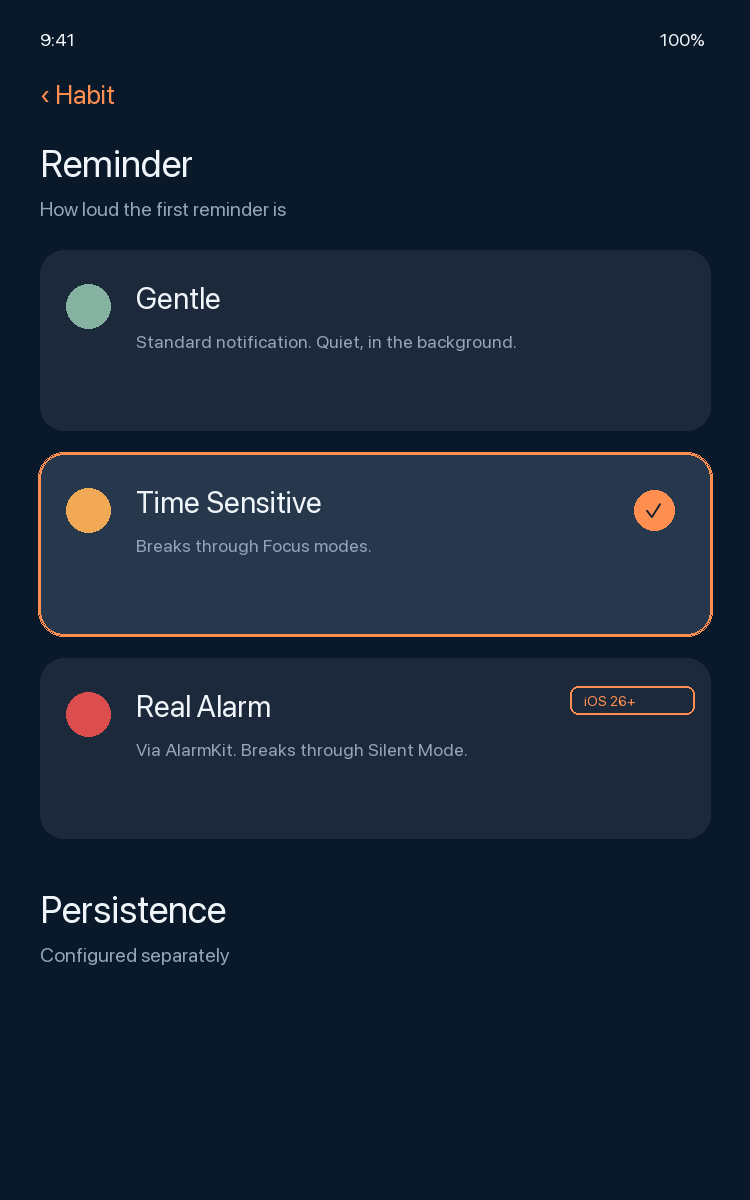
You decide per habit how loud the first reminder gets to be.
Gentle
Standard notification. Quiet, fades into the background. Good for habits you want a nudge for without being pulled out of flow.
Time Sensitive
Breaks through Focus modes. Delivered with higher priority. Good for habits that really need to happen on time.
Real Alarm (iOS 26+)
Delivered via AlarmKit. Also breaks through Silent Mode. For anchor habits like wake-up or medication. On older iOS versions this tier is cleanly disabled.
What changed in v1.1.14
One picker with four options: Gentle, Time Sensitive, Persistent, Live Activity. Loudness and repeat were fused together.
- 1.Choice: one of four tiers
- 2.Persistence locked to loudness
- 3.No way to break through Silent Mode
Two pickers. Loudness and persistence separated. Real Alarm as the third loudness tier on iOS 26+.
- 1.Loudness: Gentle, Time Sensitive, Real Alarm
- 2.Persistence: configured separately
- 3.Existing habits keep their behavior exactly
What you set before stays the way you set it. You do not need to reconfigure anything.
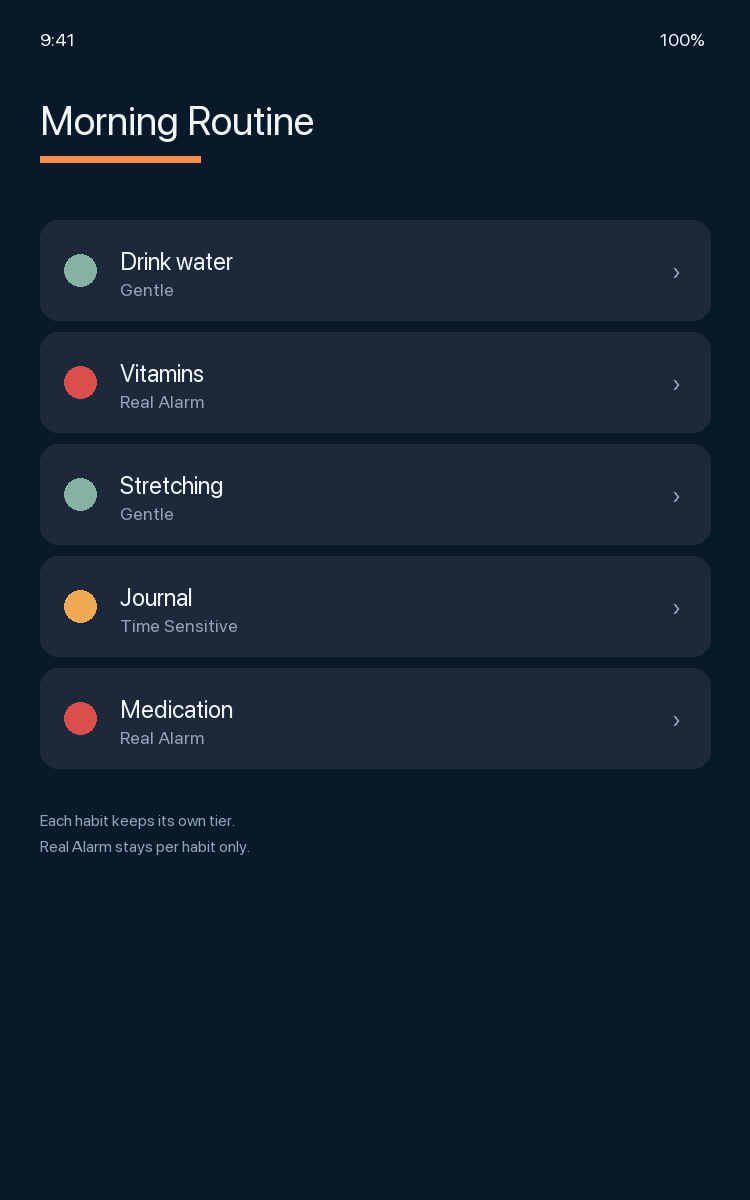
Inside your routines too
You set a habit's tier once, in Edit Habit. After that it stays out of your way. The routine view shows your progress and your next move, not how loud the reminder will be. The app handles the volume so you can focus on the doing.
From the developer — the dead-end bug from v1.1.13
In May a user messaged me: "Real Alarm does nothing when I tap it." That was the start of two weeks of debugging.
The card was dimmed because AlarmKit permission had not been granted yet. So far, expected. What was not expected: a first tap on a dimmed card is supposed to trigger the iOS permission dialog. The dialog never showed up. SwiftUI was swallowing the tap before the auth flow could even start. Dead end. The card looked dead because in that moment it was.
The v1.1.14 fix is short: the dimmed card is no longer dimmed in the tap-handler sense. It just looks dimmed. Tap, system dialog, yes or no, the card becomes live. Two weeks of bug archaeology for a handful of lines telling SwiftUI that disabled-look and disabled-interaction are two different things.
Why AlarmKit at all. iOS 26 finally gave us an official API for real alarms. Before that you had to work around it with silent background audio, Live Activities, or other hacks that all carried baggage. For a habit that has to actually happen, like medication or waking up, standard notifications are not enough. When your phone is silenced, the standard channel stays silenced. AlarmKit does not.
A compliance side note: there are a few forum threads claiming Apple requires AlarmKit apps to be standalone or single-purpose. That is not what Apple actually requires. They require an honest usage description in the Info.plist and a legitimate use case. For DopaLoop, "medication and routine anchors for ADHD users" is about as legitimate as a use case gets.
What got clearer to me through all of this: ADHD and anchor routines need hardware guarantees. Notifications are soft guarantees, they arrive if the system decides they matter enough. If your medication routine depends on the system deciding it matters enough, you have the wrong lever. The tier below, the standard channel, is fine for habits you would do anyway when you remember. But the habits you do not remember on your own are exactly the ones that need real volume.
That was also the reason to split loudness and persistence in v1.1.14. In the old model both sat inside one choice, which meant: anyone who wanted loudness got persistence baked in, and the other way around. Those are independent questions. How loud the first time? How stubborn after that? One says nothing about the other. Now they are two pickers. Whatever you had set keeps working. No one wakes up tomorrow morning with an alarm that used to be a whisper.
Up next is a separate toggle for repeat frequency on anchor habits. That was supposed to be part two of the split, but it would have pushed the v1.1.14 release. It will land in v1.1.16 at the latest.
If you build an ADHD app, you know this pattern: every feature step is also an anti-shame step. Real Alarm for medication is not "you need more discipline." It is "your brain works differently, here is the right loudness for it." That was the reason to build this in the first place. The dead-end bug cost two weeks. The right feature underneath was right the whole time.
Frequently asked questions
About the author
Stephan Eberle · Founder, DopaLoop
I'm Stephan, a senior engineer with 25+ years on the job and a late-diagnosed ADHDer. I'm building DopaLoop for the brains that standard habit trackers grind down — private, on-device, goals-first. On Medium I write openly about shipping anxiety, hyperfocus, and the rabbit-hole portfolio effect.
Reminders that fit you
14-day free trial. Stays on your device. No card required.