Inflow teaches you about ADHD. DopaLoop helps you live with it.
Inflow is a well-designed CBT-based course app for ADHD -- structured modules, expert content, community features. Acquired by Cerebral in March 2026, it now bridges coaching and telehealth. But courses end. Daily life doesn't. DopaLoop is the flexible daily tool that stays with you after the lessons are over.

The Honest Comparison
Inflow pioneered ADHD-specific app support and was acquired by Cerebral in March 2026. The approaches differ in important ways.
| Feature | DopaLoop | Inflow |
|---|---|---|
| Approach | Flexible daily habit tracker | Structured CBT course modules |
| Privacy | 100% on-device | Cloud-based |
| Goals-First | Habits linked to goals | Course-driven structure |
| Apple Watch | 3-second check-ins | Not available |
| HealthKit | Auto-tracking | Not available |
| Voice Journaling | On-device (WhisperKit) | Not available |
| Price | See App Store | From $14.99/month |
As of April 2026. Information based on publicly available data.
Why Users Switch to DopaLoop
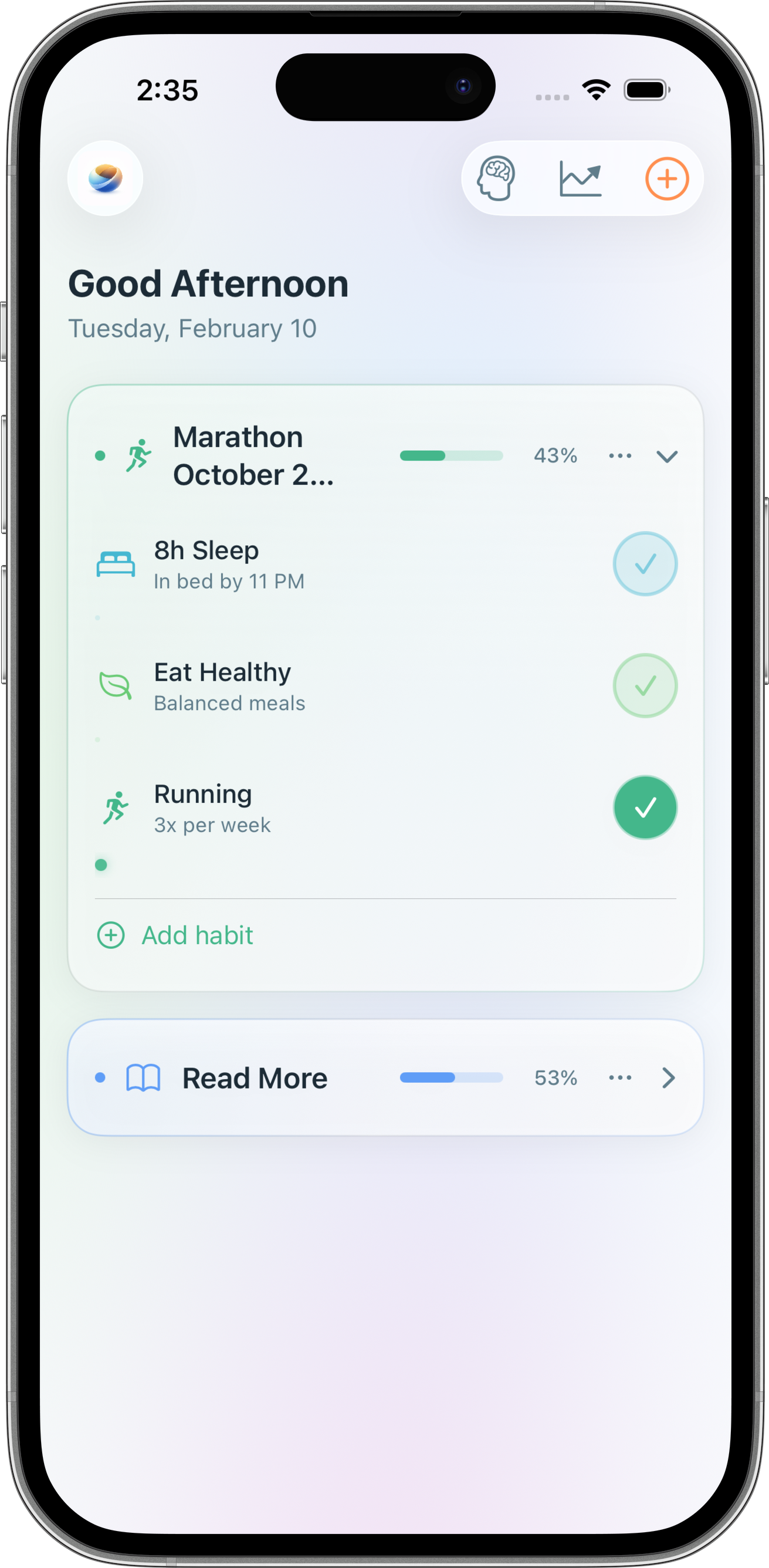
Daily tool, not a course you finish
Inflow's strength is education -- structured modules about ADHD, CBT techniques, expert guidance. Since the Cerebral acquisition (March 2026), it also bridges to telehealth services. But courses end. DopaLoop is the daily companion for after the learning phase. Build habits, track progress, maintain what you've learned.
100% on-device privacy
Inflow stores your data on cloud servers. Your ADHD journey, your struggles, your progress -- on someone else's infrastructure. DopaLoop keeps everything on your device. No servers. No accounts. No data that could be breached.
Goals-First: Your habits have direction
Inflow structures learning into courses. DopaLoop structures action into goals. Every habit serves a purpose you defined. Not a curriculum -- your life.
Voice Journaling with WhisperKit
Too exhausted to type? Just speak. WhisperKit transcribes on your device. Inflow doesn't offer voice journaling.
Apple Watch for 3-second check-ins
Track from your wrist without pulling out your phone. When ADHD makes every friction point a deal-breaker, this matters.
Lifetime pricing available
Inflow charges from $14.99/month with no lifetime option. DopaLoop offers a one-time lifetime purchase. Pay once, use forever. No subscription anxiety.
Switching Is Easy
From Inflow to DopaLoop in minutes
- 1Reflect on what you learned in Inflow's courses -- which strategies actually stuck?
- 2Create goals in DopaLoop that turn those strategies into daily action.
- 3Add the habits that support your goals -- with intensity tracking for flexible days.
- 4Keep what you learned. Build on it daily. No course to complete -- just life to live.
From the developer — different tool, same toolbox
Inflow isn't a habit tracker — and that matters
I'm Stephan, 48, diagnosed with ADHD at 47, and I tried Inflow seriously for a few weeks. Up front: Inflow and DopaLoop aren't in the same toolbox. This page has "inflow-alternative" in the title because that's how Google searches for it — but the more honest framing is "Inflow or DopaLoop." Both have a place. If I convince you by the end of this page to install both, the page did its job.
Inflow is a CBT-based (cognitive behavioral therapy) ADHD coaching app. It doesn't replace therapy, but it delivers structured psychoeducation — modules on procrastination, impulsivity, avoidance, emotion regulation, plus daily new content. Currently around $48 per month with live coaching, $22 per month as a learning app only (2026 prices, subject to change).
DopaLoop is a tool for daily use. You open it at a traffic light, tick off a habit, close it. 30 seconds. Inflow is a learning journey. You take 15–30 minutes and work through a module. Two different time budgets, two different purposes.
What Inflow does well for ADHD brains
Inflow builds on CBT principles that are well-supported in ADHD research as effective psychological interventions for adults. A meta-analysis by Knouse, Teller & Brooks (2017, Journal of Consulting and Clinical Psychology) reviewed 32 CBT-treatment studies for adult ADHD and found effect sizes comparable to the "well-established" behavioral therapies for children with ADHD. Inflow translates that into app form: not therapy, but tools standing in the same tradition.
For someone just diagnosed — the way I was nine months ago — that structured learning experience is exactly what you often only get after months in a clinical practice. What is dopamine dysregulation? What is RSD? How does time blindness actually work? Inflow has cleanly built modules on these, written by people with clinical backgrounds.
Edward Hallowell, who effectively founded the modern adult-ADHD literature with Driven to Distraction (1994), has worked for decades with an explicitly strengths-based coaching model. Inflow stands in that tradition: not "fix your deficit," but "learn the strategies that work for this brain." That's the actual value proposition.
The community layer — live coaching calls, peer discussions — addresses the isolation many late-diagnosed adults describe. If you're the type who learns by talking with others, the coaching tier (~$48/month) is real value.
Where Inflow doesn't reach for daily life
What makes Inflow strong — structured learning modules with substantive text and reflection prompts — is also its limit. ADHD brains in the acute phase ("I'll forget to eat today if nothing reminds me") don't need a module. They need an anchor.
Concretely: Inflow helps me understand why my reward system doesn't respond to a two-week deadline. DopaLoop helps me drink a glass of water this morning. Two different problems. Trying to solve one with the tool for the other ends in a bad day.
Second thing: Inflow demands reading time. App Store reviews regularly note that the modules involve "a lot to read" — which with ADHD-typical limited reading patience is a real friction point. Opening an app in your worst ADHD week and seeing six paragraphs of CBT theory means closing it again.
Third: Inflow syncs over servers, has account logins, collects behavioral data to improve the app. That's industry-standard for coaching platforms — and it's the prerequisite for the community features. But if you want the same privacy standard for ADHD data as for banking data, you have an architectural conflict with Inflow.
What DopaLoop does differently — and what it explicitly doesn't
What I don't replace:
- CBT learning content. If you're looking for psychoeducation, Inflow is the right address. DopaLoop has no learning modules, no coaching, no community.
- Coaching, therapy, clinical intervention. I'm a software engineer, not a psychologist. If you're just diagnosed and need psychoeducational material, go to Inflow or directly to a therapist.
What I do instead:
- Tool for daily use, 30-second touch. Tick a habit, set intensity 0–5, on with the day. No module, no reflection, no calendar booking.
- Goals-First. Habits hang off goals, with weight. The central display is goal progress, not a module counter.
- Local, no account. No cloud storage. No user DB. No analytics SDK. Watch sync runs through
WatchConnectivity. It's technically impossible for anyone other than me on my device to see the data. - Goals-oriented display directly uses the reward system. Volkow et al. (2009, JAMA) showed that the mesolimbic dopamine system is measurably reduced with ADHD — fewer D2/D3 receptors in the nucleus accumbens region. An app that shows "you're 62% closer to your goal" produces more activation than "you've checked 14 boxes." That's architecture, not a marketing claim.
When to use Inflow, when DopaLoop, when both
Take Inflow if:
- You're just diagnosed and need structured psychoeducation
- Coaching and community matter to you, you learn by talking with others
- You have 15–30 minutes a day of learning budget without it eating your reserves
- The monthly price ($22–48) fits your budget
Take DopaLoop if:
- You need a tool for daily life, not a learning journey
- 30-second touches are your realistic engagement maximum
- Goals-First logic is a stronger anchor for your brain than module learning
- Local-only, no account, is non-negotiable
- You're Apple-only (iPhone + optional Watch)
Take both if:
- You're just diagnosed AND need a daily tool — Inflow for the theory, DopaLoop for the practice. That's honestly my own setup in the first months after diagnosis.
This isn't a competitive statement. It's a functional description. Habit tracker and coaching app are different tools. Looking for one and getting the other ends in disappointment. Knowing both lets you combine them.
Frequently Asked Questions
About the author
Stephan Eberle · Founder, DopaLoop
I'm Stephan, a senior engineer with 25+ years on the job and a late-diagnosed ADHDer. I'm building DopaLoop for the brains that standard habit trackers grind down — private, on-device, goals-first. On Medium I write openly about shipping anxiety, hyperfocus, and the rabbit-hole portfolio effect.
From learning to doing
ADHD-friendly daily habit tracking. 100% private. Goals-First.