The Best Habit Trackers Compared
Looking for the right habit tracker? I compared the most popular apps - focusing on privacy, ADHD-friendliness, and the Goals-First approach. Including my honest take as the maker of DopaLoop.

Feature Comparison at a Glance
The most important features of popular habit trackers in direct comparison.
| DopaLoop | Streaks | Habitica | Habitify | Productive | |
|---|---|---|---|---|---|
| Goals-First | Yes | No | No | No | No |
| 100% On-Device | Yes | Yes | No | No | No |
| ADHD-Optimized | Yes | No | No | No | No |
| Intensity Scale | 0-5 | No | No | Partial | No |
| Voice Journaling | Yes | No | No | No | No |
| HealthKit | Yes | Yes | No | Partial | Partial |
| Apple Watch | Yes | Yes | No | Yes | Yes |
| Price | From 3.33 Euro/mo | 5.99 Euro one-time | Freemium | From 4.99 Euro/mo | From 3.99 Euro/mo |
DopaLoop
Streaks
Habitica
Habitify
Productive
From the developer — honestly compared
Why is a developer writing a comparison page about his own app?
I'm Stephan, 48, diagnosed with ADHD at 47, and over the past two years I've tried roughly every habit tracker the App Store surfaces when you search "ADHD" in the keywords. Not as competitive intel. Out of frustration.
This page isn't the usual comparison table where the author's own app happens to win every column. That's marketing bullshit and my brain would fall asleep reading it. The real question isn't "why is DopaLoop better than X." It's: which app works for which ADHD profile — and where my own app actually fits.
I built DopaLoop because after 25 years building software — nine of them at XING/kununu in Hamburg until I was let go in an early-2026 layoff round — I couldn't find an app built for a late-diagnosed ADHD brain. Most habit trackers are written for people who are already reasonably consistent. They reinforce consistency. They don't produce it. With ADHD that's the wrong order.
What habit trackers usually get wrong
Russell Barkley, one of the most influential ADHD researchers of the past quarter century, framed it cleanly back in 1997 in ADHD and the Nature of Self-Control: ADHD isn't primarily an attention disorder, it's a self-regulation disorder. If that's right — and the neuropsychological research has largely converged on it — then a habit tracker that presupposes self-regulation is the wrong tool for exactly the brain that doesn't meet that precondition.
Three defaults sit in nearly every app, and they backfire on ADHD brains:
Binary completion. You meditated or you didn't. Ran or didn't. Two minutes instead of twenty? The app records nothing. With ADHD-typical executive dysfunction, "nothing happened" is often the lie of the day. Two minutes was everything available. That should count.
Streaks as reward and punishment. Streaks motivate while they're running. Once they break — and they break, because life isn't binary — the ADHD brain translates the red zero into "I screwed up again." That isn't self-pity. It's Rejection Sensitive Dysphoria (RSD), which fires hard for many people with ADHD. (What RSD is, in one of our articles.)
Habits without an overarching goal. You track ten habits in parallel. Each day brings ten checkmarks. For what? If the answer is "because the app asks me to," the reward system is idling. Dopamine doesn't release when the task feels pointless. Volkow et al. (2009) in JAMA showed that the mesolimbic reward system works measurably differently with ADHD — fewer D2/D3 receptors in the nucleus accumbens region. Checking off ten meaningless things isn't enough of a signal.
If you're looking for an app that helps your brain switch on in the morning, the question isn't "which app has the prettiest checkmarks." It's: which app is built for these three defaults?
The seven competitors — short and honest
Streaks is the look-and-feel reference. Apple Design Award 2016, currently a one-time 6.99 € in the German App Store (similar elsewhere), deep HealthKit integration, and the circle grid on the home screen is what everyone copies. If you're iPhone-only, want few options, and binary streaks work for you: Streaks is always a defensible choice. What it doesn't have is an intensity scale or a goal hierarchy — by design, not by omission. (Deeper Streaks comparison.)
Habitica is the RPG variant. Free, with XP, gold, and quests. For some people with ADHD this genuinely works — the immediate reward after every check-off is exactly the short dopamine hit a binary list doesn't deliver. What Habitica isn't: quiet. If you want an app that gives you fewer stimuli, Habitica is the opposite. (Habitica in detail.)
Habitify is the cross-platform choice — iOS, Android, Watch, Mac, Web, all synced. Around 30 USD per year on subscription, or roughly 60 USD lifetime (regional pricing varies). If you live in two device worlds (Windows at work, iPhone privately) and want analytics, it's the most polished option. What Habitify isn't: local-only privacy. Sync runs over their cloud, which is the price of platform breadth. (Deeper Habitify comparison.)
Inflow isn't really a habit tracker — it's a CBT-based ADHD coaching app. Roughly 48 USD per month with coaching, 22 USD without (2026 prices, subject to change). If you've just been diagnosed and want structured psychoeducation, Inflow is content-rich. What Inflow doesn't replace: a tool you tap open at a traffic light. The learning-curve focus is both its strength and its limit. (Inflow vs DopaLoop.)
HabitKit does one thing beautifully: GitHub-style heatmap, 4 habits free, about 42 USD for a lifetime purchase, no account. It's small, fast, and the visual idea of "calendar surface fills in" gives the brain a different cue than streaks or quests. What it doesn't have: goals, intensity, voice notes. It's minimalism as strategy — and that's legitimate. (HabitKit alternative.)
Productive and Bearable are the two I have the least to defend against. Productive serves the "solid iOS app" lane, Bearable comes from symptom-tracking (mental health) and overlaps with habits only at the edges. If you're tracking mood and sleep alongside habits, Bearable is the more honest choice than any pure habit tracker. (Productive · Bearable)
What DopaLoop does that the other six don't
These three things aren't "better" — they're different, and for a particular brain profile they hold:
-
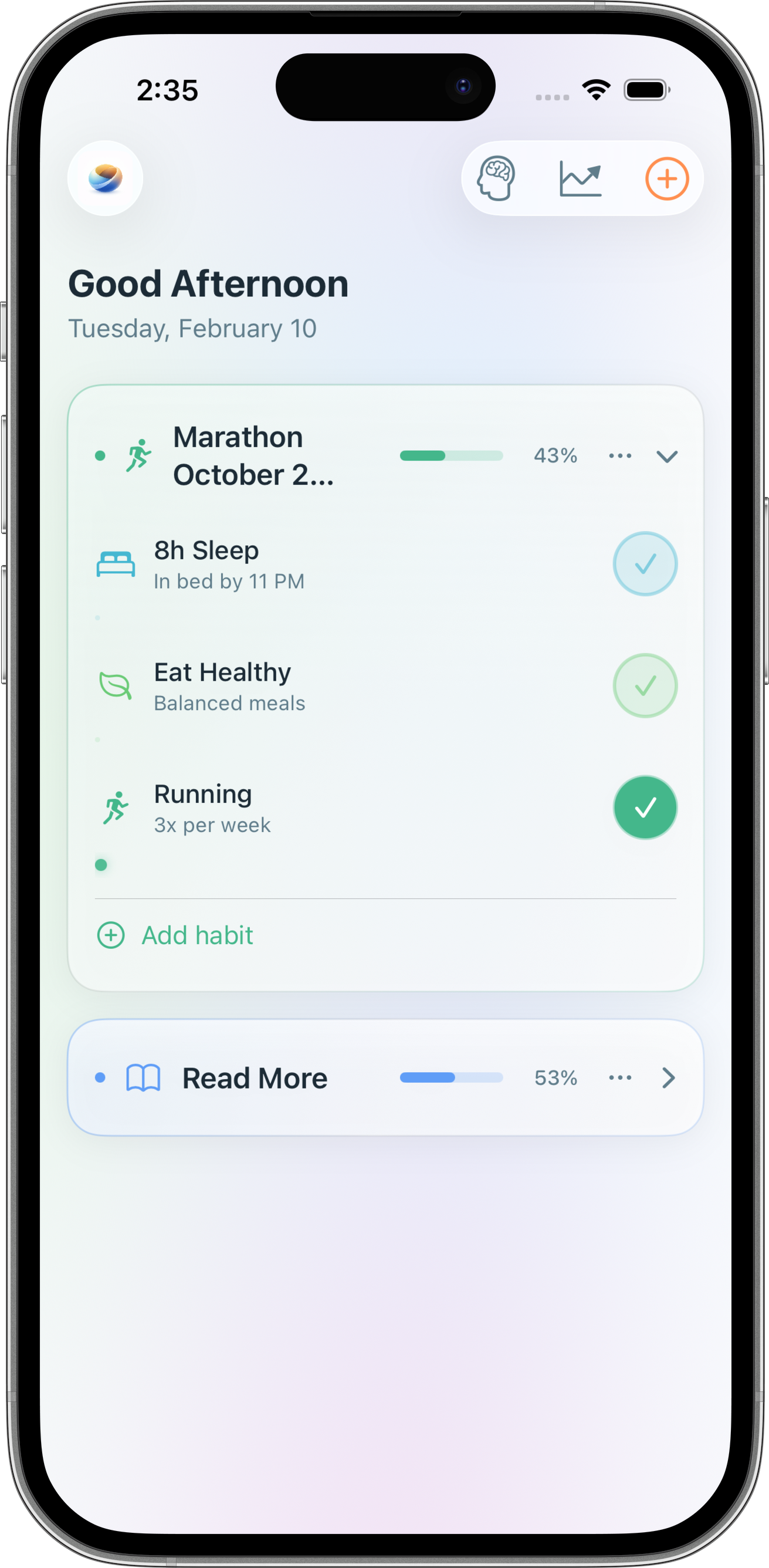
Goals-First. Habits are tools, not ends. You start with a goal ("sleep through the night again," "make it through a day's plan without it collapsing"), then a handful of habits hang off it that meaningfully move that goal. Each habit has a
goalWeight. Goal progress is what the app shows up front — not a checkmark counter. That addresses the "checkmarks without meaning" problem above directly. -
Intensity 0–5. Habit completion isn't binary. Zero means "not today," five means "better than expected." With ADHD-typical fluctuating energy, three-out-of-five is the most common state, and a binary app systematically erases it.
-
Local, no account, no cloud. The app talks to no server, has no user DB, no analytics SDK. Apple Watch sync runs through
WatchConnectivity(device-to-device, no iCloud detour). Backup goes through the standard iOS backup, optionally with Apple's Advanced Data Protection. That isn't "privacy as marketing" — it's architecture. It's technically impossible for anyone except me on my device to see the data.
What DopaLoop explicitly isn't: a coaching program, therapy, a cross-platform solution (iOS and Watch, no Android, no Web), or a gamified RPG. If you need that, you opened six tabs above this one.
What this comparison page honestly can't tell you
Which app holds for you, no table can know. Habit apps get abandoned after two weeks. The app still on your phone after three months is the right one — regardless of star count.
My suggestion if you're new to DopaLoop: one goal, three habits, two weeks. See whether the intensity scale takes pressure off or whether you ignore it. See whether the goal display pulls you forward or feels interchangeable. If your ADHD brain still opens the app after two weeks, you've found a tool it can use. If not, one of the alternatives above. No shame.
I'm not selling the app as a fix for a brain deficit. It's a tool. One I built for myself because I couldn't get along with the others. If the same three defaults annoy you too, you're in the right place.
The Apps in Detail
DopaLoop
I'm biased - I built DopaLoop. But that's exactly why I can explain the thinking behind it: I wanted a tracker that doesn't just collect checkmarks, but asks 'What are you doing this for?'. Goals-First means every habit serves a purpose. Add to that: all data stays on your device, the intensity scale (0-5) allows nuance instead of yes/no, and voice journaling lets you capture thoughts by just talking.
Streaks
Streaks has strong fundamentals: minimalist design, Apple Design Award 2016, one-time purchase ($5.99 for all Apple platforms), data stays on device. HealthKit auto-tracking, 78 themes, 600+ icons. For people who want to check off up to 24 daily habits, it's an excellent pick. What Streaks doesn't offer: a connection between habits and bigger goals, and tracking is purely binary (Yes/No).
Habitica
If you love RPGs, you'll love Habitica: your avatar earns XP for completed habits, you unlock armor, and you can quest with groups. Completely free to use (subscription is cosmetic-only), open source, with community features like parties and guilds. But the punishment system (HP loss, avatar death, damaging friends) can trigger shame spirals with ADHD and RSD. No Apple Watch, no HealthKit. Data runs through cloud servers (PrivacySpy: 5.3/10).
Habitify
Habitify's biggest strength: it runs everywhere. iOS, Android, Web, Mac, Apple Watch - the best cross-platform coverage of any tracker. NFC tags, Zapier/IFTTT integration, CSV export. Free tier allows 3 habits, Premium from $4.99/mo, Lifetime ~$59.99. The trade-off: your data lives on their servers, and Goals-First or ADHD-specific features aren't part of the package.
Productive
Beautiful swipe UI, 3 habit types (positive/negative/timed), curated programs and Siri Shortcuts. Productive also offers visionOS support and Android. But: no HealthKit, extensive data collection by Bending Spoons, no lifetime price (only ~$6.99/mo or ~$34.99/yr). For Goals-First or ADHD optimization, you'll need to look elsewhere.
Conclusion: Which Habit Tracker Is Right?
I won't claim DopaLoop is the best app for everyone. But if privacy, ADHD understanding, and a goal-based approach matter to you, the alternatives fall short. For minimal tracking, Streaks is unbeatable on price. Gamification fans should try Habitica. Need multi-platform? Habitify is your only option.
More Guides
HabitKit Alternative
DopaLoop as an alternative to HabitKit.
→Streaks Alternative
Streaks is elegant. DopaLoop goes deeper.
→Habitica Alternative
Habitica is fun. DopaLoop is understanding.
→Inflow Alternative
Inflow is ADHD coaching. DopaLoop is your daily tracker.
→Habit Tracker Guide
Everything about habit trackers and the Goals-First approach.
→Frequently Asked Questions
About the author
Stephan Eberle · Founder, DopaLoop
I'm Stephan, a senior engineer with 25+ years on the job and a late-diagnosed ADHDer. I'm building DopaLoop for the brains that standard habit trackers grind down — private, on-device, goals-first. On Medium I write openly about shipping anxiety, hyperfocus, and the rabbit-hole portfolio effect.
Ready for the Goals-First approach?
Try DopaLoop free for 14 days. All features, cancel anytime.